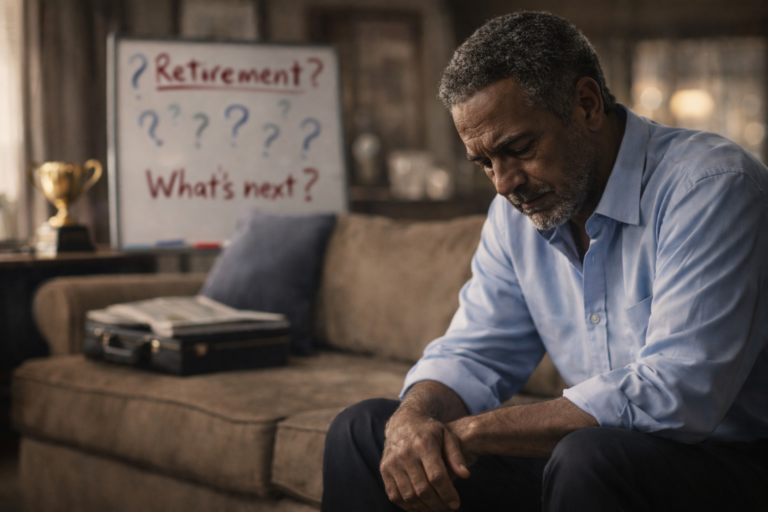
Shadow Burnout: Why High Performers Are Breaking Down in Plain Sight

The Performance Stays. Everything Else Goes.
There is a scene most people in this category recognize, even if they have never named it.
It is early morning. Before anyone else is awake. The phone is already lit up — overnight messages, a board question, something that needs a response before 8am. The response gets written. It is good. Precise. It projects the right level of confidence. And the person who wrote it sits back and feels almost nothing.
Not relief that it’s handled. Not curiosity about what comes next. Not even the low-grade irritation that at least signals engagement. Just a kind of flatness — a muted quality where something more alive used to be.
The day proceeds. The performance holds. Nobody notices.
Shadow burnout in high performers, as a clinical construct, describes persistent exhaustion and cynicism hidden beneath continued high performance. The external face remains intact. The internal architecture is eroding. The gap between what is projected and what is actually experienced widens over months, sometimes years, until something forces a reckoning — a health event, a relationship crisis, a decision made from a depleted state that cannot be walked back.
A 2025 survey of 127 California tech founders conducted by CEREVITY found that 73 percent were experiencing shadow burnout while maintaining external performance metrics. Among those, 68 percent were actively concealing their mental health struggles from investors, board members, and leadership teams. The primary barrier to seeking support: 61 percent cited fear of professional consequences. The founder mental health crisis these numbers describe is not a Silicon Valley anomaly — it is a structural feature of high-stakes leadership at any level.
Those numbers describe founders. The same structural dynamic appears in executives, senior partners, athletes still competing, and family office principals who cannot afford — professionally or psychologically — to be seen as anything other than functional.
Why Shadow Burnout in High Performers Hides Inside Competence
Standard burnout follows a recognizable arc. Performance declines. Something flags. Someone intervenes, or the person intervenes themselves. The collapse is visible enough to respond to.
Shadow burnout doesn’t follow that arc because the people most susceptible to it are too skilled at functioning under pressure for the normal signals to appear.
High performers have spent careers building capacity to perform despite internal states. The executive who presents with clarity under board scrutiny while privately managing significant anxiety has refined that skill over decades. The athlete who competes at full intensity three days after a personal crisis has trained their nervous system to compartmentalize with precision. The capacity that makes them effective is the same capacity that masks what’s deteriorating.
Research from the University of California, San Francisco has documented that entrepreneurs are approximately 50 percent more likely to report mental health conditions than the general population — not because they are less resilient, but because the structural conditions of high-stakes leadership create elevated vulnerability. Financial instability, identity fusion with the role, isolation within the command position, and the cognitive load of decisions that carry existential weight are not temporary stressors. They are the operating conditions of the role. The nervous system isn’t designed for indefinite high-alert functioning, regardless of how much experience someone has performing in that state.
What shadow burnout does to cognitive function is worth naming specifically. It degrades decision quality before it degrades output volume. A founder may still be shipping product while their strategic judgment has quietly narrowed. An executive may still be managing effectively while their capacity for nuanced thinking — the kind that catches the second-order consequences of a decision — has been compromised by months of inadequate recovery. The work continues. The quality of the most critical thinking has already been affected. This is the mechanism by which shadow burnout creates serious professional consequences long before anyone identifies it as a mental health concern.
CEO Burnout Concealment: Why Hiding It Worsens the Problem
Sixty-eight percent of the founders in the CEREVITY survey were actively concealing their mental health struggles from stakeholders. That number reflects a rational calculation, not a failure of self-awareness.
For someone whose professional standing, investor relationships, or team confidence depends on projecting stability and competence, acknowledging internal deterioration carries real consequences. The board chair who confides in a fellow board member that he hasn’t slept well in months and finds himself disengaged from work he used to find meaningful has just introduced doubt into a relationship that needs to run on confidence. The founder who tells her lead investor that she hasn’t been herself lately has created a data point that investor will carry into every future conversation.
The concealment is strategic. It is also the mechanism through which shadow burnout worsens.
Isolation is one of the primary amplifiers of psychological deterioration. The person who cannot acknowledge their internal state to the people around them has no outlet for the pressure and no feedback loop to help them assess their own condition accurately. The concealment removes the social corrective that might otherwise prompt earlier action. It creates a closed loop: the worse things get internally, the more energy goes into maintaining the external presentation, the more depleted the internal reserves become, the harder it is to acknowledge the problem.
This is why shadow burnout tends not to resolve on its own. The conditions that create it — sustained pressure, isolation, the impossibility of visible vulnerability — are the same conditions that prevent natural recovery.
Why Standard Resources Don’t Reach Hidden Burnout Executives
Therapy, as a resource, has a specific entry barrier for people at this level: it requires a person to publicly acknowledge — to an insurance company, a scheduling system, a receptionist — that something is wrong.
For someone whose professional identity depends on the appearance of stability, that entry barrier is not trivial. The 61 percent who cited fear of professional consequences were not being paranoid. Insurance claims create records. Appointments leave digital trails. The infrastructure of the standard mental health system was not designed with this specific concern in mind, which means it functionally excludes the people who most need discretion.
Peer support structures present a different problem. The executive peer group, the founder community, the leadership forum — these are environments where vulnerability requires trusting that the people across the table do not have competing interests. At this level, they often do. The wealth manager who is also a peer knows things. The fellow board member who offers a sympathetic ear is still a board member. The community of people who ostensibly understand the pressure is also a community of people whose perception of you carries professional consequence.
The result: the person experiencing shadow burnout is surrounded by high-functioning, intelligent people — and is, in any meaningful sense, completely alone with what is actually happening.
What the Timing Problem Actually Looks Like
Shadow burnout does not announce its arrival. It accumulates.
The early markers are easy to rationalize: shortened patience for things that used to be manageable, a slight flattening of affect that doesn’t rise to the level of concern, a growing distance from the work that once felt meaningful. Not enough to flag. Enough to notice privately and file away.
Weeks pass. Months. The flattening deepens. Decision quality degrades. Sleep becomes either excessive — the body forcing recovery the person won’t allow consciously — or insufficient, the mind too activated to disengage. Relationships that used to be restorative start to feel like demands. The narrowing of internal bandwidth reaches into the places that were once protected from it.
By the time the situation has become acute, the person has usually spent six to eighteen months managing it in isolation, having decided at every prior inflection point that it wasn’t yet severe enough to do anything about. The threshold keeps moving. The concealment has become practiced. The support infrastructure — whatever existed — has been kept at a distance.
What addresses shadow burnout is not a program. It is not a retreat. It is not a wellness initiative.
It is a relationship — specifically, a clinical relationship — that exists before the threshold is reached. The person who is still performing, still concealing, still deciding that it isn’t quite bad enough yet, is the person this kind of relationship was built for. Not after the crisis. Before it. Kyden Point was built on this recognition — that the relationship has to exist before the threshold is reached, not be assembled in response to it.
That relationship can exist without insurance, without records, without a waiting room. It can be episodic — engaged when the conditions warrant, structured around what actually needs to happen, not around a treatment calendar. It does not require the person to step back from the role or to acknowledge anything in a setting that carries professional consequence.
The nature of what is being addressed matters more than the modality. Shadow burnout is not a mood disorder that emerged in isolation. It is the predictable result of sustained high-alert functioning, compulsory concealment, and the structural isolation that comes with operating at altitude. Understanding those structural dynamics is the prerequisite for addressing them.
The deterioration that happens in plain sight is the hardest kind to catch. It hides in the performance. It wears the right clothes and sends the right emails and presents with the right level of confidence. The person inside it often doesn’t call it burnout. They call it a rough stretch, a difficult quarter, a period they’re managing through.
They are usually more depleted than they know. The gap between what they project and what they experience has been widening for longer than they’ve acknowledged. That gap has a cost. It always does.
Schedule a consultation with Kyden Point →
Frequently Asked Questions
What is the difference between burnout and shadow burnout?
Burnout, in its classical clinical definition, involves emotional exhaustion, depersonalization, and a reduced sense of personal accomplishment — typically visible as declining output, disengagement, or an inability to function at previous levels. Shadow burnout shares those internal features but diverges in one critical way: the external performance remains intact. A person experiencing shadow burnout continues to meet or exceed professional expectations while the internal systems that sustain that performance are eroding. The absence of visible decline is precisely what makes shadow burnout harder to identify and address. A 2025 CEREVITY survey of 127 California tech founders found that 73 percent were experiencing shadow burnout while maintaining external metrics — a figure that reflects how common functional concealment of internal deterioration is at high-performance levels.
How do you know if you’re experiencing shadow burnout?
Shadow burnout presents with a specific pattern of markers that differ from visible burnout. The early indicators include flattened affect — doing the work without the engagement that used to accompany it — a shortened tolerance for friction that previously felt manageable, and a slow withdrawal from the things that once felt meaningful. Decision quality often degrades before output volume declines: the thinking narrows, the second-order considerations get missed, the strategic clarity that used to come readily requires more effort to access. Sleep patterns shift in either direction. The gap between what is projected externally and what is experienced internally becomes a source of its own cognitive load. The defining characteristic is that the person continues functioning at a high level while privately experiencing exhaustion, cynicism, and a growing sense of disconnection from the role. Most people who are in it describe a rough stretch, a difficult period, something they’re managing through — not burnout. That reluctance to name it accurately is part of the clinical picture.
Why are high performers more vulnerable to hidden burnout?
The very capabilities that make someone effective at a high-performance level are the same capabilities that mask high performer burnout. High performers have typically spent careers building a refined ability to perform despite internal states — to present with clarity under pressure, to compartmentalize acute stress during critical moments, to maintain external composure when the internal situation is complicated. That skill does not stop functioning when the internal depletion reaches the level of clinical concern. It continues operating, keeping the presentation intact well past the point where a person with less developed coping mechanisms would have shown visible signs of deterioration. Research from the University of California, San Francisco has documented that entrepreneurs — a high-performance population with comparable structural demands — are approximately 50 percent more likely to report mental health conditions than the general population, not because they are less capable but because the structural conditions of high-stakes leadership generate elevated and sustained psychological load.
Can someone be burning out and still performing at a high level?
Yes. This is the defining feature of shadow burnout as a clinical construct. The condition is characterized specifically by the persistence of high-level external performance alongside persistent internal exhaustion and cynicism. The performance does not reflect the internal state, and the internal state does not disrupt the performance — at least not in the early and middle stages. What degrades before visible performance does is decision quality. The executive still runs the meeting effectively, but the judgment applied to the highest-stakes strategic decisions has narrowed. The founder still ships product, but the thinking that catches second-order consequences is operating on diminished capacity. The deterioration is internal and cognitive before it becomes behavioral or output-based, which is why the standard metrics used to identify burnout — performance reviews, output tracking, visible behavioral changes — are not reliable early indicators for this population.
What makes shadow burnout harder to address than regular burnout?
Three structural features distinguish shadow burnout from visible burnout in ways that complicate intervention. First, the concealment is active. Sixty-eight percent of founders experiencing shadow burnout in the CEREVITY survey were deliberately hiding their struggles from investors, boards, and leadership teams — a rational response to the professional risk that acknowledgment carries. Active concealment removes the social correctives that sometimes prompt earlier action. Second, the standard entry points for support — therapy referrals, employee assistance programs, peer support forums — all require a level of acknowledgment that carries professional consequence for someone whose standing depends on projecting stability. Sixty-one percent of founders cited fear of professional consequences as their primary barrier to seeking care. Third, shadow burnout does not follow the visible arc of visible burnout. There is no performance decline to flag, no obvious crisis to respond to, no behavioral change that prompts intervention. The deterioration is internal, the timeline is long, and the person inside it has usually been managing it in isolation for months to years by the time the situation becomes acute. What addresses it is a clinical relationship that exists before the threshold is reached — not a resource activated by crisis, but a relationship built before one. This is the structural gap Kyden Point was designed to address.
What does shadow burnout look like to someone who works with or alongside a high performer?
From the outside, shadow burnout often reads as subtle and easy to rationalize. The executive is still performing. The founder is still shipping. The metrics are still good. What a close observer might notice: slightly shortened patience in conversations that previously would have gone smoothly, responses that are competent but lack the engagement or strategic texture they once carried, a small but perceptible withdrawal from the relationships or discussions that used to generate visible energy. The affect is flatter — not in a way that is alarming, but in a way that is different from baseline. For referral sources — wealth managers, family attorneys, executive coaches, concierge physicians — the pattern of hidden burnout in executives is sometimes described as “something seems slightly off” without a specific behavior to point to. That observation is usually accurate. The absence of a specific, nameable problem does not mean the problem isn’t present. Shadow burnout is defined by its invisibility to standard observation. The person who prompts a quiet “is he okay?” from someone who knows them well is frequently further along in the deterioration than the question implies.
Sources
- CEREVITY, “73% of Tech Founders Report a Hidden Mental Health Crisis” (2025 survey of 127 California tech founders), published December 2025, clinically reviewed May 2026.
- Freeman, M.A., et al., “The prevalence and co-occurrence of psychiatric conditions among entrepreneurs and their families,” Small Business Economics (2019).
- University of California, San Francisco, foundational research on entrepreneur mental health prevalence.